


Rebuilding Net Zero Consensus
To Reposition Net Zero as the People’s Hero: Restoring Public Support for Green Energy
On the 12th of March at the House of Commons, the Net Zero All-Party Parliamentary Group (APPG) hosted their first of three planned sessions in their 2026 Rebuilding Net Zero Consensus series. The first session was entitled Making Net Zero Work for Households. A written agenda dispersed prior to the event outlined a few subjects to be discussed by the panellists:
- Building consumer demand for clean technologies
- How to deal with deterrents of implementing renewable energy, such as the high upfront costs and confusing choices
- Misinformation and mistrust around heat pumps, EVs and renewables
- How to best position green energy as practical and fair while promoting the benefits of lower energy bills, warmer and healthier homes and greater energy security
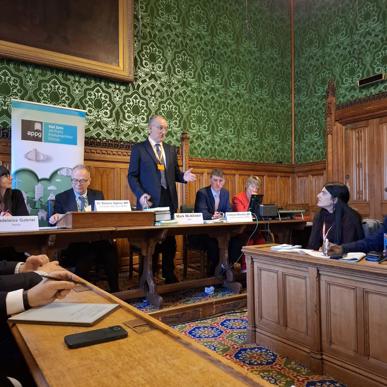
Group Co-Chair, Dr. Simon Opher, MP, began the evening with an amiable welcome then introduced the panel of clean energy experts. His genuine zeal to arrive at some achievable goals around his question of “how to sell net zero to the public” was evident. His charge to the panellists as well as the session’s attendees was to find ways to positively “change peoples’ hearts and minds” regarding the UK’s transition away from fossil fuels and toward renewable energy.
Heat Networks, Bombs and Innovative Practicality
Mark McAllister, from Ofgem, was the first to hold court. He didn’t shy away from his concerns about the Iranian bombs that had struck Dubai just a few days earlier. The incident had already resulted in a spike in oil prices. Renewable energies, he said, are one answer to escaping “the volatility of fuel costs” due to wars, natural disasters and a handful of other unpredictable events.
He also spoke about “the benefits of heat networks.” A heat network is a thermal distribution system that moves hot water (and sometimes cooling) from a central energy centre to buildings via underground pipes. Instead of each home having its own boiler, residents share the use of community boilers, large industrial heat pumps and/or geothermal heat. Presently, only 2% of UK homes use this renewable and cost-effective type of communal heating. Mr. McAllister hopes to boost the current number of homes that implement heat networks by ten times, to one in five UK homes.
Madeleine Gabriel from NESTA, a research and innovation foundation, spoke of overcoming barriers to decarbonisation. She stated that innovation in the green energy sector will eventually make renewables “practical to the everyday person.” For now, however, there is a need to build public “confidence in the technology” so that those considering renewable fuels can be certain that these new, clean fuels will keep them warm when they need it while also reducing their energy bills for decades to come. Ms. Gabriel believes that to effectively “sell net zero to the public” the “costs and benefits should be discussed first.”
Doctors Prescribing Heat and the Power of Not Mentioning Net Zero
Peter Smith, from the charity National Energy Action (NEA), focused on the physical and mental health benefits of living in a warm home versus the illnesses that fall upon those who live in a persistently cold home. The NHS spends hundreds of millions of pounds every year treating those with cardiovascular problems, asthma, COPD and other conditions that have been caused by living in a chilly house.
He spoke about heat on prescription, a healthcare-led intervention for those with illnesses that have been made worse by living in a cold home. These individuals are prescribed financial support or energy credits so they can heat their homes to a safe, healthy temperature. Essentially, heat on prescription is prescribing warmth as form of medicine.
He stated that residents have been cured of previous ailments due to living in a warm home after years surviving in a cold house. Before-and-after x-rays, he said, “show the improvement in peoples’ lungs.”
Dr. Aaron Gillich teaches at London South Bank University and is a professor of Building Decarbonisation and the Director of the BSRIA LSBU Net Zero Building Centre. He voiced his concern about the long-term strategy regarding the ways we can get “gas out of homes. No one talks about how we do that.”
The decarbonisation issue is further complicated by the growing scepticism and stigma surrounding the term net zero. Dr. Gillich believes the expression carries too much baggage. With the political polarisation and emotional fatigue around net zero–related policies, Dr. Gillich would like to stop talking about net zero. Instead, we should focus on getting rid of damp and mould. He said that a positive side effect of “eliminating damp and mould from UK homes,” if done correctly, will result in a huge reduction in gas consumption. A natural by-product of tackling damp and mould is reaching the nation’s decarbonisation goals. All without mentioning net zero, decarbonisation or renewable energy.
Heat Pumps, Misinformation and a Sea Change
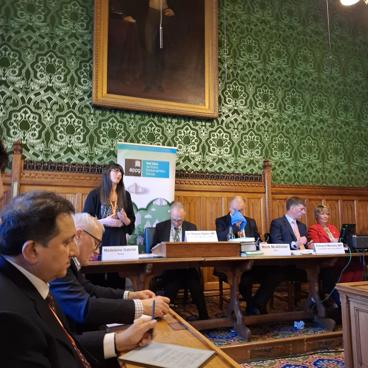
Pippa Heylings, an MP since July 2024, was a last-minute addition to the panel. She began by stating that the preceding five days of war between Iran and Dubai had already cost “more money than the UK would need to hit our 2050 decarbonisation targets.” Shifting to the subject of misinformation, she said that “a small group of voices have gotten louder in their opposition to net zero.” Though she admitted that there are times when nature seemed to be at odds with net zero (the infrastructure needed for large decarbonisation projects can require a lot of digging and other earthworks), Ms. Heylings was adamant that most of the voices opposed to green energy had a vested interest for their gas-forward positions.
The other APPG Co-Chair, Edward Morello, MP, was the last of the panel to present his opinions. He started with the advantages of air-source heat pumps. A hurdle, he admitted, was that “they take a long time to install. A new, gas boiler can be fitted in half a day.” He looked forward to the time when it would no longer take between two and five days to properly install an air-source heat pump.
Shifting to electric vehicles, Mr. Morello mused about the number of years it took the public to embrace EVs. Now, he said, “EVs are viewed as an upgrade.” Optimistic, the MP envisioned the same sea change occurring with implementing renewable energies to power homes.
He went on to cite that the £100+ billions required to upgrade the National Grid and its transmission systems isn’t much different than what it would cost to achieve net zero. Mr. Morello finished with the tens of thousands of jobs that would be created by embracing a full green agenda.
Bold Q’s, Astute A’s
The discussion that followed proved as lively as the panel itself: a swirl of clarifications, talk of old habits dying hard and a birth of new anxieties coming with nearly every question. What emerged, more than any single solution, was the scale of the psychological work ahead. Britain doesn’t just need heat pumps, insulation and communal energy networks; it needs to rediscover its confidence in progress.
If the APPG hoped to find a simple way to “sell net zero to the public,” they didn’t get it. What they did get was something more valuable: a clear view of the cultural headwinds that just might make the bridge leading to decarbonisation impassable. The public isn’t rejecting clean energy; it’s rejecting the confusion, cost and political noise that tag along with every mention of net zero. Until we learn to speak in ways that filter out the noise, even the best ideas will struggle to find purchase.
Still, for one evening in Room 9 of the House of Commons, there was at least a shared willingness to try. And in a political and cultural moment defined largely by hesitation, that may be the closest thing we have to momentum. What remains to be seen is who will be bold enough to stand up rather than stand back.
Post
-
Energy Capital Collaboration Day
19 Feb 2026
-
Warm Homes Plan: What It Means for Social Housing and the UK’s Solar Future
22 Jan 2026
-
Welcoming HI Group – Expert Solutions in Decarbonisation and Sustainability
09 Jan 2026
-

Sureserve Goes International
19 Dec 2025
-
Energy, Ideas and Optimism
02 Dec 2025